Cities on the Move
1997
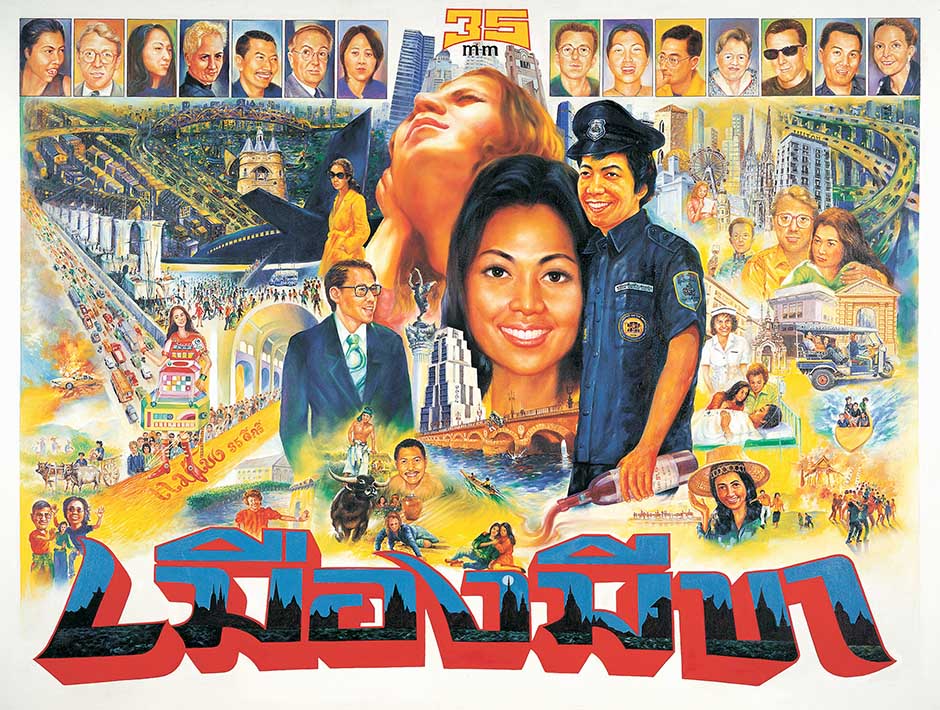
A large touring exhibition charting the emergence of Asian cities at the end of 1990’s, Cities on the Move was the brainchild of Hans-Ulrich Obrist and Hou Hanru who in collaboration with several art institutions and local initiates, produced seven versions that included more than 100 international artists and architects. In a collaboration of two Thai artists, Rirkrit Tiravanija and Navin Rawanchaikul, two three-wheeled tuk-tuks from Bangkok were transported to European cities for this exhibition. The tuk-tuk is a cheap, noisy, “poor man’s” mode of transport, known as a quintessential symbol of Thailand, but also signifies the developing world. A divergence on the taxi gallery theme that the two artists collaborated on in Bangkok a year before, within the passenger area of the vehicle was a couple of small video cameras with LCD monitors that aired Rirkrit’s video work from the Navin Gallery Bangkok exhibition along with footage of tuk-tuks touring host cities and Bangkok. Passengers were invited to record their own thoughts using the camera provided with the collective footage screened on another camera. Both stocked with free postcards depicting classic images of tuk-tuks in Thailand, one tuk-tuk was supposed to drive around each host city, while the other parked up inside the gallery. For the Bangkok leg of the exhibition, 20 tuk-tuks were sponsored by the vehicle’s manufacturer, being used as a shuttle bus between venues and exhibiting invited artists works inside.
Emulating the old hand-painted movie posters popular in India and Thailand, it marked the first occasion that Navin’s signature vintage billboard paintings were produced, with a series of Cities on the Move paintings narrating a faux movie plot that responded to each of the exhibition’s locations. Reproduced as posters and billboards, the paintings were widely shown in public spaces including local papers. There was significant merchandising also, with a miniature tuk-tuk toy, t-shirts and custom-made jackets, and in collaboration with French designer brand agn’s b. a limited-edition tuk-tuk driver shirt was produced.
A year after the end of touring, both tuk-tuks reappeared in Aachen city in Germany for a group show called Continental Shifts, with one of them finally finding a new home in central Brazil. A poster series was also presented at the Rotterdam Film Festival in 1998 and in 2000 archival tuk-tuk films were shown on a large advertising screen in the centre of Seoul for the first Media City Seoul.
